

Building Multi Stage Boss Fights

A great boss fight should feel different from every battle that came before it.
When the players finally confront the villain they have been hearing about for an entire campaign, defeat the ancient creature that has terrorized a region, or enter the chamber of a powerful supernatural being, the encounter should feel like a major event. Unfortunately, one of the easiest ways to make a boss battle disappointing is to treat the boss as nothing more than a creature with a large amount of health and powerful attacks. A memorable tabletop RPG boss fight needs escalation.
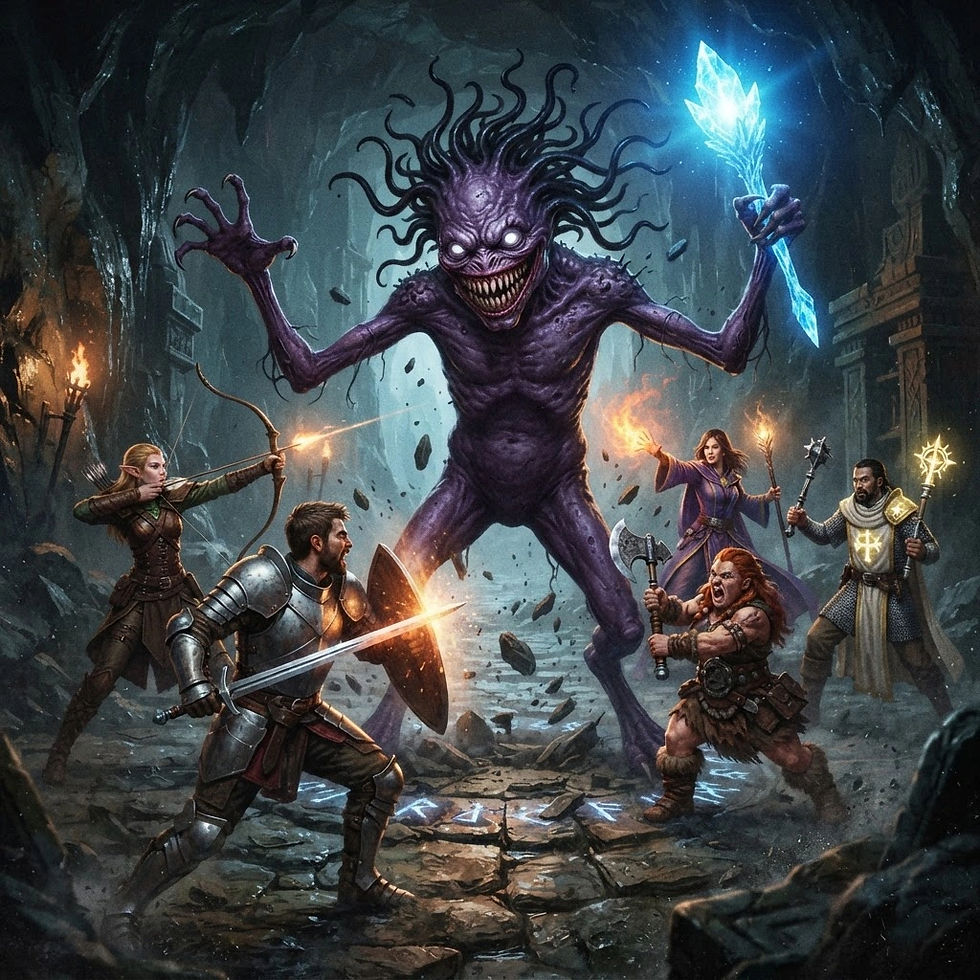
This is where multi stage boss fights become one of the most useful tools available to a Game Master. Instead of creating one static enemy that behaves exactly the same way from the beginning of combat until the end, a multi stage boss encounter allows the battle to evolve as the players make progress. The battlefield can change. The boss can reveal new abilities. The villain can alter tactics. The stakes can increase. The players may discover that what they thought was the final form of the enemy was only the beginning.
For Game Masters running fantasy campaigns, this approach can transform a conventional combat encounter into a dramatic sequence that players remember long after the dice stop rolling.
What Is a Multi Stage Boss Fight?
A multi stage boss fight is a tabletop RPG encounter in which a major enemy changes its abilities, tactics, environment, objectives, or behavior as the battle progresses.
The simplest version might involve three distinct stages. The boss begins the encounter in its normal form. After suffering significant damage or experiencing a particular event, it enters a second phase with new abilities or tactics. Eventually, the encounter reaches a final stage where the boss becomes more dangerous, the environment becomes unstable, or the consequences of failure become much more severe. However, a multi stage boss battle does not necessarily require the boss to transform physically.
A powerful enemy might begin the encounter as a calculating strategist before becoming increasingly desperate. A necromancer might abandon defensive magic and unleash forbidden spells when the ritual is interrupted. A dragon might take flight after losing half its health, completely changing the battlefield. An ancient guardian might activate previously dormant magical defenses. A divine entity might stop fighting physically and begin attacking the characters through their minds, memories, Faith, or surroundings.
The important element is change. Players should feel that the battle is developing rather than simply repeating the same sequence of attacks.
Why Multi Stage Boss Battles Work So Well
One of the biggest problems with traditional boss encounters is repetition. The characters identify the boss's basic strategy, discover the most effective way to attack it, and then repeat that strategy until the creature's health reaches zero. Even if the boss has impressive statistics, the encounter can become predictable.
Multi stage encounters solve this problem by introducing new information. When the boss changes, the players have to reconsider their strategy. The attack that worked five rounds ago might suddenly become ineffective. The safest location on the battlefield may become dangerous. A previously ignored environmental feature may suddenly become important. The players may have to decide whether to continue attacking the boss directly or deal with a new threat.
This creates one of the most important elements of exciting RPG combat, meaningful decisions. The goal is not simply to make the boss stronger. The goal is to make the situation different.
Gods of Aumin's broader approach to Game Mastering emphasizes encounters in which players have meaningful choices rather than simply exchanging attacks until one side is defeated. Its combat design philosophy also encourages objectives, environmental complications, creative problem solving, and encounters that accomplish something beyond simply reducing hit points. Multi stage boss design naturally supports this philosophy.
Start by Designing the Boss's Story
Before determining how many phases a boss should have, determine what the boss represents in your story. A boss should have a reason to exist.
Perhaps this enemy has been manipulating events throughout the campaign. Perhaps it guards an ancient artifact. Perhaps it wants to complete a ritual. Perhaps it is attempting to escape. Perhaps the characters have been hunting it for months. Perhaps the creature is not evil at all and believes the heroes are the ones threatening its world. Understanding the boss's motivation makes it much easier to determine how the encounter should evolve.
Imagine an ancient sorcerer attempting to open a portal to another realm. During the first stage, the sorcerer might fight defensively while maintaining the ritual. During the second stage, the characters damage the magical structure and destabilize the portal. During the third stage, the sorcerer abandons the ritual and draws power directly from the unstable portal.
Now the phases are not arbitrary mechanical upgrades. They are consequences of what is happening in the story. That distinction is extremely important. A phase should answer the question: What has changed?
Build the First Phase Around Discovery
The first phase of a boss encounter should introduce the players to the threat. Do not necessarily reveal everything immediately. The opening stage can establish the boss's personality, fighting style, major abilities, and relationship with the environment. It gives the players an opportunity to observe.
Perhaps the boss is incredibly fast. Perhaps it barely moves but controls the battlefield. Perhaps it uses minions. Perhaps it attempts to manipulate one character. Perhaps it seems almost invulnerable. The first phase should give the players information that they can use later. This makes the opening portion of the battle feel like an investigation.
Players might notice that the boss protects one particular object. They might discover that its magical shield weakens whenever it uses a certain ability. They might realize that the creature cannot cross a particular symbol on the floor. They might discover that attacking the boss directly is less effective than manipulating the environment.
The Game Master does not necessarily need to announce these weaknesses. Let the players discover them. That discovery becomes part of the reward.
Make the Second Phase a Meaningful Escalation
The second phase should change the encounter rather than simply increase the boss's damage. This is one of the most common mistakes in boss design.
If a creature has 500 hit points in phase one and suddenly has another 500 hit points in phase two, the players may simply feel as though the fight has become longer. Instead, introduce a new problem. The boss could gain flight. The floor could begin collapsing. The room could fill with magical energy. The boss could summon allies. The creature might split into multiple forms.
The original objective might change. An important NPC might become endangered. The boss could begin destroying the location around the characters. Suddenly the players have something new to think about.
A strong second phase often makes players say, “Wait, what are we supposed to do now?”
That is exactly what you want.
Give the Final Phase a Different Identity
The final stage should feel like the culmination of the encounter. At this point, the boss should no longer behave exactly as it did at the beginning.
Perhaps the villain becomes desperate. Perhaps the creature abandons defense and unleashes everything it has. Perhaps an ancient power awakens. Perhaps the boss begins destroying the world around it. Perhaps the final phase reveals the truth about the enemy. This is also an excellent opportunity to connect the boss fight to the campaign's larger story.
If the villain has been searching for an artifact throughout the campaign, perhaps the artifact activates during the final stage. If the boss has been attempting to ascend into godhood, perhaps the final phase is the moment that transformation begins. If the players have spent an entire campaign learning about an ancient civilization, perhaps defeating the boss finally reveals what destroyed it.
The final phase should answer questions while creating new consequences.
Don't Make Every Phase About Hit Points
A phase does not have to activate at 75%, 50%, and 25% health. Health thresholds are useful because they are simple and predictable for the Game Master, but they are not the only way to structure a multi stage boss fight.
A phase can begin when the players destroy an artifact. It can begin when a ritual reaches a certain point. It can begin when the boss loses an important ally. It can begin when a particular character discovers the boss's secret. It can begin after the players successfully complete an objective. It can even begin because the players make a particular choice. This creates a more dynamic encounter.
For example, imagine a demon imprisoned beneath an ancient temple. The characters are not supposed to simply kill it. They need to destroy three magical seals holding it in place. At first, the demon is weak and chained.
After the first seal is destroyed, the demon becomes mobile. After the second seal is destroyed, it gains access to powerful magic. When the third seal breaks, the demon becomes enormously dangerous. The players have effectively created their own boss phases through their actions. That is much more interesting than simply telling them that the monster transforms at 50% health.
Use the Battlefield as Part of the Boss
A multi stage boss fight becomes much more memorable when the environment evolves with the encounter. The battlefield should not necessarily remain static for ten or twenty rounds.
A magical tower could begin collapsing. A volcanic chamber could fill with lava. An ancient temple could awaken. A storm could become increasingly violent. A portal could expand. A battlefield floating in the sky could begin breaking apart. A divine throne room could slowly transform into another plane of existence.
These changes create natural escalation without requiring the boss to become impossibly powerful. They also give players more ways to interact with the encounter. A character might use a collapsing pillar as a weapon. Another might activate an ancient mechanism. Someone else might leap across a widening gap to reach an important objective.
This approach supports high agency Game Mastering because players are not limited to the actions written on their character sheets.
Create Multiple Objectives
A boss fight becomes significantly more interesting when defeating the boss is not the only thing that matters.
Perhaps the characters must protect an NPC. Perhaps they need to prevent an artifact from being destroyed. Perhaps they must stop a ritual. Perhaps they need to escape before the entire dungeon collapses. Perhaps they must keep the boss occupied while another character completes a magical ritual.
This creates a crucial distinction between winning the fight and achieving the objective. A party might technically defeat the boss but fail to save the city. They might stop the ritual but allow the villain to escape. They might defeat the creature but accidentally destroy the artifact they came to recover. These outcomes make boss battles feel connected to the campaign instead of isolated combat encounters.
Gods of Aumin's Game Master material repeatedly emphasizes that encounters become more engaging when combat contains meaningful objectives, environmental complications, and opportunities for creative player solutions.
Let Player Choices Trigger Consequences
One of the strongest techniques for multi-stage boss design is allowing the players to determine how the encounter develops. Suppose the boss has three magical relics providing its power. The players can attack the boss directly, but they can also destroy the relics.
If they destroy the first relic, the boss loses its defensive ability. If they destroy the second, it loses access to a powerful spell. If they destroy the third, the boss becomes enraged and enters its final form. Now the players are making strategic decisions rather than simply attacking the highest value target.
They might decide to destroy the relics first. They might ignore them and attempt to overwhelm the boss. They might use one relic against another. They might even discover an unexpected solution.
The Game Master's role is not necessarily to predict which approach will succeed. The role is to create a situation that reacts meaningfully to the players' decisions.
Make the Boss Intelligent Without Making It Unfair
A powerful boss should generally behave according to its intelligence and personality. A legendary strategist should not repeatedly make obviously terrible decisions. A terrifying predator should not ignore wounded prey. A divine entity should not fight like a common bandit.
At the same time, intelligence should not become an excuse for the Game Master to counter every player strategy. The boss should respond to what it knows, not what the Game Master knows. If the characters successfully hide their plan, the boss should not magically anticipate it simply because the Game Master understands the players' strategy.
This principle protects player agency. The boss can be brilliant while still being surprised. In fact, allowing players to outsmart a powerful enemy can create some of the most satisfying moments in a campaign.
Design Phases Around the Boss's Personality
Every phase should reveal something about the enemy. A proud villain might become increasingly furious when wounded. A calculating mastermind might become increasingly desperate. A religious fanatic might sacrifice its followers. A monster might become more instinctive as it loses control. A god might become less human as its divine nature emerges.
These behavioral changes make phases feel like character development. The players are not simply fighting Phase One, Phase Two, and Phase Three. They are watching a character unravel, transform, adapt, or reveal its true nature. That is storytelling through combat.
How Multi Stage Boss Fights Fit Gods of Aumin
Multi stage encounters are particularly useful in a mythic fantasy RPG where characters can grow far beyond ordinary adventurers.
Gods of Aumin is designed as a classless, skill based fantasy tabletop RPG set in the world of Krystarum. Characters develop through skills, experience, Faith, Reknown, meaningful choices, and long term progression rather than being restricted to traditional character classes. The game's larger progression can move characters from mortal adventurers toward heroes, demigods, and eventually gods. That progression creates an interesting opportunity for Game Masters. The scale of the opposition can grow alongside the characters.
Early campaigns might feature dangerous warriors, monsters, cult leaders, and dungeon guardians. Later adventures can introduce legendary creatures, ancient supernatural entities, powerful rulers, divine forces, and enemies capable of affecting entire regions or realms.
Multi stage boss design helps bridge those scales. A powerful enemy does not have to be defined solely by enormous statistics. It can be defined by what happens when the players challenge it.
A mortal tyrant might become a supernatural creature. A legendary monster might awaken an ancient power. A demigod might begin manipulating the battlefield itself. A god might turn the entire environment into an extension of its will. The larger the campaign becomes, the more valuable this type of encounter design becomes.
How to Avoid Making Multi Stage Boss Fights Too Long
There is an important danger with multi stage encounters: length. A multi stage battle should feel like escalation, not repetition.
If every phase requires the players to reduce another enormous pool of hit points, the excitement will eventually disappear. Instead, make each phase accomplish something different. The first phase might be about learning. The second might be about adaptation.
The third might be about survival. The final stage might be about making a decisive choice.
You can also allow a phase to end early when the players accomplish its objective. If they destroy the magical engine powering the boss, there is no reason to make them spend another five rounds attacking it. Let success accelerate the encounter. This keeps the battle dramatic while respecting player creativity.
Give the Players Warning Before the Transformation
Sudden transformations can be exciting, but foreshadowing makes them even better.
Describe cracks forming across the boss's armor. Let ancient symbols begin glowing.
Have the creature mention an ability it has not yet used. Allow the players to notice that the environment is becoming unstable. Perhaps the boss whispers an ancient name before beginning the transformation. These details create anticipation.
When the second phase finally arrives, players should ideally think, “We knew something like this was coming.”
That creates tension rather than confusion. Foreshadowing also rewards players who pay attention.
Make Victory Change the Campaign
The conclusion of a great boss fight should matter.
The villain's defeat might change political power in a kingdom. It might release an imprisoned creature. It might destroy an ancient barrier. It might reveal a hidden civilization.
It might give the characters control over an artifact. It might cause a god to notice them. It might change their Faith or Reknown. It might open the path toward a completely new chapter of the campaign. This is particularly powerful in long form fantasy campaigns. A boss fight should ideally leave a mark.
When players realize that defeating an enemy has permanently changed the world, the battle becomes more than an encounter on a map. It becomes part of the history of their characters.
The Secret to a Great Multi Stage Boss Fight
The secret to building a great multi stage boss fight is not creating more abilities, more hit points, or more complicated mechanics. It is creating meaningful escalation. The players should enter the encounter understanding one problem and leave having faced something completely different.
The battlefield should evolve. The boss should reveal itself. The players should discover information. Their choices should influence what happens next. The objectives should matter. The consequences should extend beyond the final attack. Most importantly, every stage should give the players a reason to change what they are doing. That is what separates a multi stage boss fight from a long combat encounter.
A memorable boss battle tells a story through gameplay. The players learn, adapt, take risks, overcome setbacks, discover weaknesses, and ultimately create the outcome themselves.
Whether you are running D&D, Pathfinder, RuneQuest, a classless fantasy RPG, or Gods of Aumin, the principle remains the same: build a situation that evolves as the players interact with it.
In a world like Krystarum, where mortal characters can follow a Path of Ascension toward legendary and divine power, that philosophy can extend all the way from a dangerous creature lurking in a forgotten ruin to conflicts involving beings capable of reshaping the world itself. Gods of Aumin is built around that larger journey, combining classless character development, skill based progression, Faith, Reknown, and an expanding mythic fantasy setting.
The best boss fight is not the one with the most complicated statistics. It is the one your players are still talking about months later. The moment the villain transformed. The room collapsed. The plan almost failed. Someone discovered the weakness. Someone made the impossible choice.
And when the final phase began, everyone at the table knew that the adventure had become something much bigger than an ordinary battle.


Comments