

Building Boss Battles Players Remember

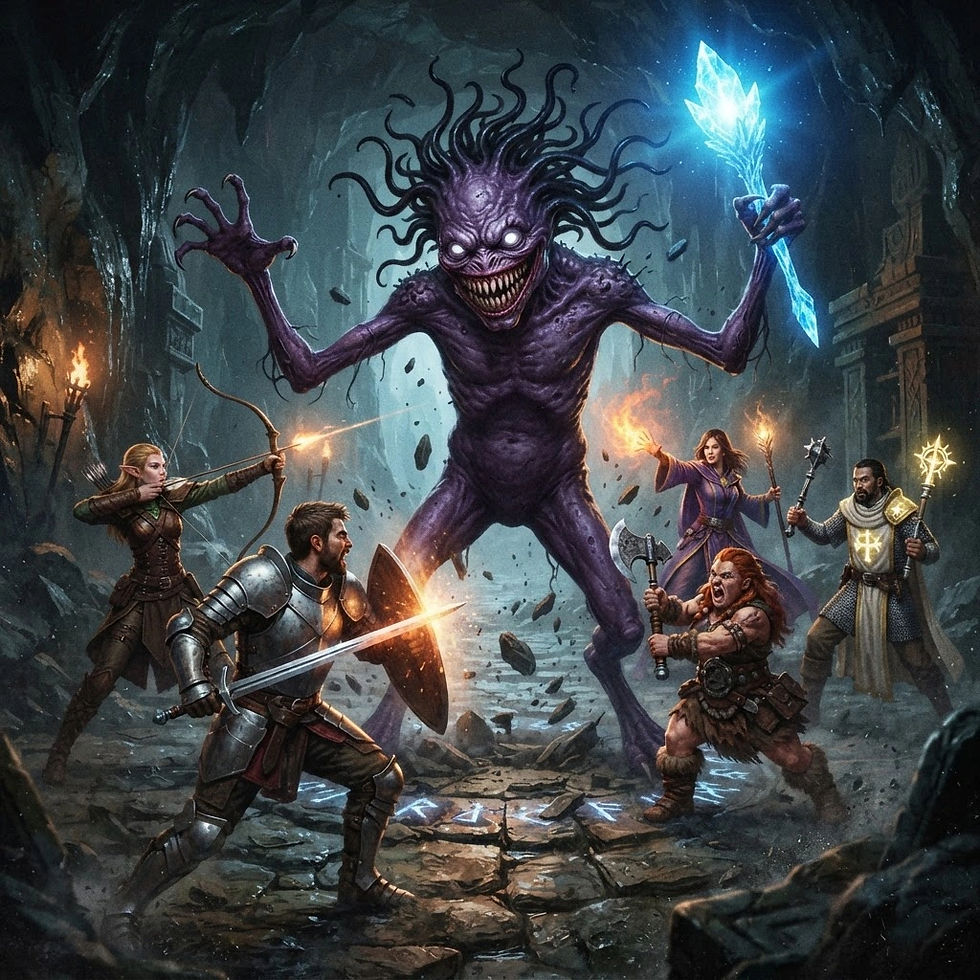
A great boss battle can become one of the defining moments of a tabletop roleplaying campaign. Months after the adventure ends, players may forget the name of a random tavern, the treasure they found in a dungeon, or even the details of an ordinary combat encounter. But they are far more likely to remember the night their battered party stood on the edge of defeat, faced an impossible enemy, made one desperate decision, and somehow changed the course of the story.

For Game Masters, designing that kind of encounter requires more than giving a powerful monster a huge pool of hit points. A memorable boss fight needs tension, personality, meaningful choices, tactical variety, narrative stakes, and a reason for the players to care about what happens. Whether you are running a traditional fantasy RPG, a D100 system, a classless TTRPG, or a long form mythic campaign, the principles behind memorable boss battle design remain remarkably consistent.
What Makes a Boss Battle Memorable?
The first question to ask when designing a boss encounter is not, “How much damage should this monster do?”
It is, “Why will my players remember this battle?”
That distinction changes everything.
A boss is more than a powerful stat block. A boss should represent something within the adventure. It might embody an ancient evil, protect a forbidden secret, command an enemy faction, hunt the characters personally, or stand between the heroes and something they desperately need. The mechanical challenge matters, but the emotional and narrative context gives the battle meaning.
This is particularly important because tabletop RPG combat is fundamentally different from combat in a video game. A Game Master does not know exactly what the players will do. The party may negotiate with the villain, attempt to trap it, destroy the environment, flee, sacrifice an objective, recruit an enemy, or invent an approach that was never anticipated during preparation.
That uncertainty is one of tabletop roleplaying's greatest strengths. The best boss encounters embrace it.
Give the Villain a Reason to Exist
One of the easiest ways to improve a boss fight is to establish the villain long before initiative is rolled. Players should ideally know that something is coming.
Perhaps they hear stories about a warrior who has defeated every challenger sent against him. Perhaps entire villages have disappeared. Perhaps travelers describe strange lights over an ancient fortress. Maybe the characters discover the boss's symbol carved into ruined temples or encounter survivors who barely escaped its territory. These clues create anticipation.
When the party finally encounters the villain, the moment feels like the culmination of something rather than another random monster appearing at the end of a dungeon.
Build a Boss's Reputation Before the Battle
A boss becomes significantly more intimidating when players understand its reputation before they understand its statistics. A dragon that has 500 hit points is merely a number. A dragon whose arrival caused three kingdoms to abandon an entire mountain range is a story.
This does not mean the Game Master needs to write pages of lore. A few carefully placed details can establish enormous significance. A destroyed fortress, a terrified NPC, a legendary weapon, an ancient mural, or evidence of a previous failed expedition can tell players that they are approaching something extraordinary.
This technique also creates a natural escalation curve. The players begin with curiosity, progress into concern, and eventually arrive at genuine anticipation. By the time the boss appears, they should already have questions.
Who is this creature?
Why is it here?
What does it want?
Can we actually defeat it?
And perhaps most importantly: what happens if we fail?
Create a Boss With Personality
A memorable boss should feel like a character rather than a collection of combat statistics.
Personality gives players something to interact with before, during, and after the battle. A villain might be arrogant, patient, fanatical, honorable, terrified, amused, philosophical, cruel, or strangely compassionate. Even a monster that cannot speak can have recognizable behavior.
Perhaps it always attacks the strongest character first. Perhaps it ignores unconscious enemies. Perhaps it collects weapons from defeated opponents. Perhaps it becomes increasingly desperate as the battle progresses. Perhaps it protects something instead of attempting to kill the heroes. These details create identity.
Let the Boss Talk
Dialogue can dramatically increase the impact of a boss encounter. The villain might recognize a character's ancestry. It might reveal information the party desperately needs. It might attempt to recruit the heroes. It might insult their previous victories or calmly explain why their current quest is doomed.
The purpose is not to give the Game Master a dramatic monologue every few minutes. The purpose is to make the antagonist feel like an active participant in the story. A villain that simply waits in a room until the players arrive feels artificial. A villain that reacts to the characters feels alive.
This connects naturally with broader Game Master techniques such as NPC development, meaningful dialogue, worldbuilding, and high-agency storytelling. The goal is always to make the world feel like it continues to exist beyond the players' immediate actions.
Build a Boss Arena That Matters
A boss fight becomes much more interesting when the battlefield itself creates decisions. A flat room with four walls and a monster in the center limits the number of meaningful tactical possibilities. A dynamic environment can transform the same combat statistics into an entirely different experience.
Imagine a battle fought across a collapsing bridge above an abyss. Suddenly movement matters. Imagine a magical chamber where four crystals continuously empower the boss. Now the players have to decide whether to attack the creature or destroy the source of its power. Imagine a ruined temple where ancient statues awaken whenever blood touches the floor. The environment becomes part of the encounter.
Design Tactical Zones
Instead of thinking about the boss arena as one large space, think about it as several connected zones. One area might provide cover. Another might contain dangerous terrain. A third might contain an objective. Another might provide the boss with an advantage. This gives players reasons to move. Movement becomes meaningful when standing in one location is fundamentally different from standing somewhere else.
The same principle works in nearly every fantasy TTRPG. A battlefield might contain cliffs, magical hazards, defensive structures, civilians, ritual objects, environmental weapons, unstable terrain, or escape routes. The important thing is that the environment creates choices without becoming so complicated that the Game Master spends more time managing the map than running the encounter.
Give the Boss More Than One Way to Fight
A common mistake in RPG encounter design is creating a boss whose entire strategy is essentially, “Attack the character with the lowest defenses until someone dies.” That can be mechanically dangerous without being especially interesting.
A memorable boss should have multiple tools. It might have a devastating attack that requires preparation. It could summon creatures, manipulate terrain, create magical barriers, reposition characters, disable equipment, alter the battlefield, or exploit specific weaknesses. The goal is not to make the boss overwhelmingly powerful. The goal is to make the players constantly reconsider their strategy.
Make Players Adapt
The most exciting boss fights often contain moments where the players realize their original strategy is no longer working.
Perhaps the boss becomes resistant to their primary attack. Perhaps it destroys the bridge they were using for cover. Perhaps it summons reinforcements. Perhaps a magical shield activates. Perhaps the boss reveals an ability nobody knew it possessed. These moments force players to think rather than repeat the same action.
However, there is an important distinction between adaptation and punishment. Players should be given enough information to understand that their choices matter. If a Game Master suddenly introduces an ability solely to invalidate a successful player strategy, the encounter can feel unfair. A good boss challenges the players. A bad boss simply changes the rules whenever the players begin winning.
Use Phases to Create Escalation
One of the strongest tools for memorable boss battle design is the multi phase encounter. A boss does not necessarily need to become stronger after reaching a certain percentage of health.
Instead, the battle can evolve because something changes. The arena could collapse. The boss could abandon restraint. A magical artifact could activate. A second creature could emerge. The villain could sacrifice part of its own power. The characters could destroy an important objective. The battle could transition from a physical confrontation into a magical or supernatural one. The important concept is escalation.
Phase One Should Teach the Players
The opening phase can establish the boss's personality and combat style. Players learn what the villain can do. They discover its strengths and weaknesses. They begin developing a strategy. Then something changes.
The second phase should challenge the assumptions they formed during the first. This creates a natural rhythm: discover, adapt, overcome.
A third phase can push the encounter toward its climax, ideally making the final moments feel qualitatively different from the opening.
This approach is especially effective in mythic fantasy campaigns where characters and enemies can operate at increasingly extreme levels of power.
Give Players Objectives Beyond “Reduce HP to Zero”
Perhaps the single most important boss battle design principle is this: defeating the boss should not always be the only objective. A battle becomes more interesting when players must accomplish something while fighting.
They may need to stop a ritual, rescue a prisoner, protect an NPC, destroy an artifact, recover an object, survive for a certain amount of time, escape the collapsing fortress, or prevent the villain from reaching a specific location. This creates competing priorities.
A character might have the opportunity to deal significant damage but instead choose to save an ally. Another player might ignore the boss entirely to destroy the mechanism powering its defenses. Someone else might realize that killing the boss is actually the worst possible outcome. Suddenly, every turn carries narrative weight.
Let Player Choices Change the Battle
The best boss encounters are not completely predetermined. Players should be able to change the situation through clever decisions. If they discover that the boss is bound to an ancient artifact, perhaps destroying that artifact weakens it. If they discover that the villain is protecting someone, perhaps negotiation becomes possible. If they learn that the arena is unstable, perhaps they can manipulate the environment.
This is where high agency Game Mastering becomes particularly powerful. Instead of preparing one solution, prepare a situation. Then let the players decide what happens.
That philosophy fits naturally with systems designed around player driven progression and meaningful choices.
Gods of Aumin, for example, is built as a classless, skill based fantasy TTRPG where characters develop through experience, skills, Faith, Reknown, and long term progression rather than being confined to rigid character classes. That kind of design creates opportunities for boss encounters to become more than predetermined combat sequences. A character's unique abilities, skills, choices, and reputation can influence how an encounter unfolds.
Make Failure Interesting
A boss fight does not always need to end with either “the heroes win” or “the heroes die.”
Failure can create a new story.
Maybe the villain escapes. Maybe the characters lose an important artifact. Maybe a kingdom falls. Maybe an NPC dies. Maybe the heroes are captured. Maybe the boss completes part of its plan but not all of it. These outcomes can create powerful campaign consequences.
The key is to distinguish meaningful failure from meaningless punishment. Players should feel that their decisions created the result rather than believing the Game Master simply decided they were supposed to lose. A failed boss battle can actually become one of the most memorable sessions of a campaign if the consequences reshape everything that follows.
Make Victory Feel Earned
The final moments of a boss battle deserve special attention. Do not rush them.
If the characters have spent an hour fighting a legendary enemy, the conclusion should feel significant. Describe the environment. Show the consequences. Let the players explain what their characters do.
Maybe the final blow shatters an ancient weapon. Maybe the villain whispers one final revelation. Maybe the fortress begins collapsing. Maybe the magical energy released by the defeated creature transforms the battlefield. Maybe the characters realize they have accidentally unleashed something even worse. Victory should change the world.
Remember the Aftermath
The boss fight does not end when the enemy reaches zero health. Ask what changes because the villain is gone.
Who benefits?
Who suffers?
What becomes possible?
What power vacuum has been created?
What does the party become known for?
This is particularly important in long term campaigns. A memorable boss should leave fingerprints on the story even after its death.
In a setting such as Krystarum, where characters can progress from mortal adventurers toward increasingly powerful forms of existence, major victories can become milestones in a character's developing legend. Gods of Aumin explicitly emphasizes long form progression from mortal heroes toward demigod and god level play, giving Game Masters a natural framework for escalating the scale of future threats.
Scale the Boss to the Campaign, Not Just the Characters
A boss should feel appropriate for the point in the campaign where it appears.
An early villain might control a village, command a band of mercenaries, or terrorize a wilderness region.
A mid campaign antagonist might threaten an entire kingdom.
A late campaign enemy could manipulate nations, command supernatural armies, or possess powers capable of reshaping reality.
The escalation should feel intentional. This is particularly valuable in campaigns built around extreme character progression. If heroes eventually become demigods or gods, the Game Master needs to think beyond conventional monster statistics and begin designing conflicts around influence, civilizations, divine forces, metaphysical threats, and world changing consequences.
The boss battle eventually becomes more than a fight. It becomes a collision between powers.
Avoid the Most Common Boss Battle Mistakes
The first major mistake is making the boss nothing more than a giant bag of hit points. More health can make combat longer, but length is not the same thing as excitement.
The second mistake is making the boss overwhelmingly powerful without giving the players meaningful counterplay. Difficulty should create tension, not helplessness.
The third mistake is overcomplicating the encounter. A boss with twenty special abilities may look impressive on paper but become difficult for the Game Master to run and difficult for players to understand.
The fourth mistake is preventing players from changing the encounter. If every environmental feature is decorative and every clever idea is rejected because the Game Master has already decided how the fight must proceed, the encounter stops feeling like a roleplaying game.
The fifth mistake is making every boss fight follow the same structure. If every major villain appears in a large room, announces an attack, summons minions, reaches half health, transforms, and dies, players will eventually recognize the pattern.
Variation creates anticipation.
Build Boss Battles Around Stories, Not Statistics
The strongest boss encounters begin before combat and continue after it.
Players remember the villain who haunted them throughout the campaign. They remember the battlefield where everything went wrong. They remember the character who sacrificed themselves. They remember discovering the boss's weakness three sessions earlier. They remember the moment the villain transformed. They remember the impossible decision they made with one action remaining. They remember stories.
That is the real secret to designing unforgettable boss battles.
Statistics determine how an enemy functions mechanically, but story determines why the players care. The battlefield creates tactical possibilities. Personality creates emotional investment. Phases create escalation. Objectives create meaningful decisions. Consequences make victory or defeat matter. When these elements work together, a boss encounter becomes more than combat. It becomes a campaign milestone.
For Game Masters looking for additional encounter inspiration, the Gods of Aumin ecosystem is built around exactly this kind of mythic fantasy storytelling. The system combines D100 based skill checks, experience driven advancement, Faith, Reknown, long term progression, and a world where characters can ultimately move from mortal adventurers toward godhood.
Our Game Master Guides Blog category is also designed around encounter design, worldbuilding, NPC creation, improvisation, and campaign planning. The next time you prepare a legendary villain, resist the temptation to begin with hit points and damage.
Begin with the question your players will answer around the table long after the dice stop rolling: “What happened that night?”
If the answer is powerful enough, you have not merely designed a boss battle.
You have created a story your players will remember.


Comments