

How to Design Balanced Fantasy Combat Encounters

A great combat encounter should make players think, make meaningful choices, and feel the pressure of uncertainty without making them feel as though the Game Master has simply decided who wins. That is the heart of encounter balance. For Game Masters, one of the most common questions is deceptively simple.
How do you design balanced combat encounters?
The answer is more complicated than assigning monsters a difficulty rating and putting them on a battle map. A combat encounter can look perfectly balanced on paper and still become a boring cakewalk, an unexpected character killing disaster, or a repetitive exchange of attacks.
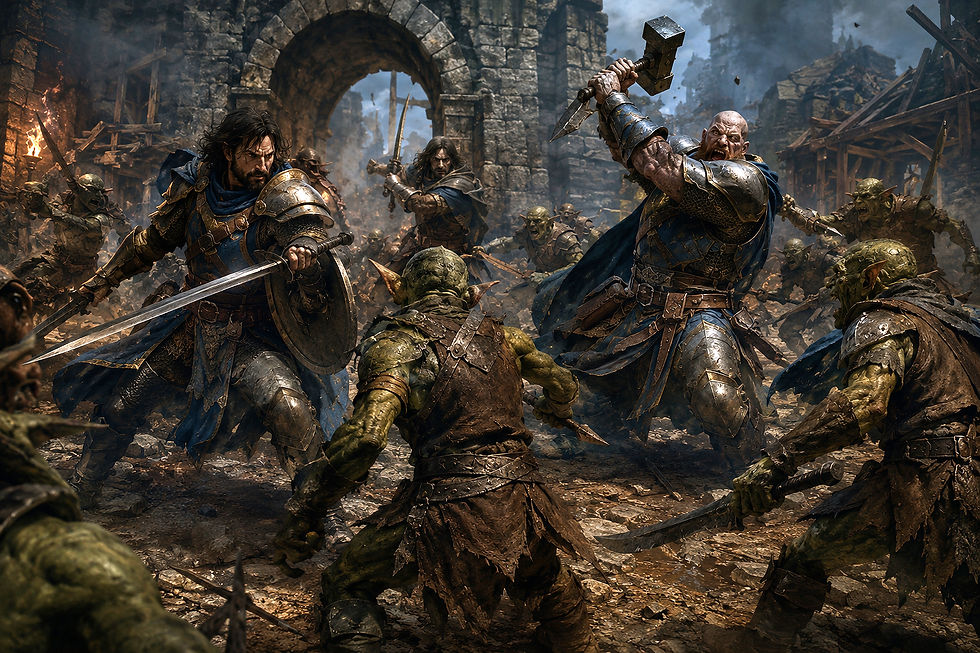
Modern encounter design increasingly emphasizes more than raw monster statistics. Action economy, terrain, objectives, party composition, player experience, enemy tactics, resource expenditure, and the narrative purpose of the battle can all dramatically affect difficulty.
For Game Masters running systems ranging from traditional fantasy RPGs to classless and skill based tabletop RPGs, the goal should not necessarily be mathematical equality. Instead, a balanced encounter should create meaningful danger without eliminating meaningful agency. That distinction changes everything.
What Does a Balanced Combat Encounter Actually Mean?
A balanced combat encounter does not mean that both sides have an identical chance of winning. In most fantasy roleplaying games, the player characters are expected to prevail against ordinary encounters. If every battle had a genuine 50/50 chance of killing the party, most campaigns would become extremely short. Instead, encounter balance is about creating an appropriate level of pressure.
A good encounter should make players consider whether they should attack, defend, retreat, reposition, use a powerful ability, protect another character, exploit the environment, or pursue an alternative objective. The players should feel that their decisions matter and that poor decisions can have consequences.
This is why encounter difficulty cannot be determined solely by comparing character levels to monster statistics. Traditional systems often use tools such as Challenge Rating, Average Party Level, experience budgets, or similar mathematical frameworks to establish a starting point. Pathfinder, for example, uses Average Party Level and encounter difficulty categories as a foundation for building combat challenges.
Those tools are useful, but they are only the beginning. A genuinely effective encounter asks a second question after determining its approximate difficulty.
What will make this fight interesting?
Start With the Purpose of the Encounter
Before choosing a monster, decide why the combat exists. This may seem obvious, but it is one of the most important principles of encounter design. A fight should ideally accomplish something beyond consuming a few minutes of game time and reducing the party's hit points.
Perhaps the characters are trying to rescue someone before an execution. Maybe they need to stop a ritual before it reaches completion. Perhaps an enemy commander is attempting to escape with an important artifact. The characters might need to hold a bridge long enough for civilians to flee, survive an ambush in hostile territory, or defeat a creature that has been terrorizing an entire settlement. The objective immediately creates additional strategic possibilities.
Instead of asking only, "How do we kill these enemies?"
Players can ask, "How do we accomplish our objective?"
That difference is enormous.
A combat encounter with an objective creates decision pressure. Players may deliberately ignore an enemy to accomplish something more important. They may split the party. They may sacrifice position for speed. They may attempt to negotiate. They may retreat temporarily and return with a better strategy.
The best combat encounters often have an answer to the question, "What happens if the players don't simply kill everything?"
Balance the Party Against the Real Threat
Once the purpose of the encounter is established, examine the party itself. Two groups of characters at the same nominal level can have dramatically different capabilities. One party may be highly optimized for direct combat, while another may rely heavily on exploration skills, social abilities, magic, ranged attacks, or unconventional tactics. Party composition matters because combat power is not distributed equally across every character.
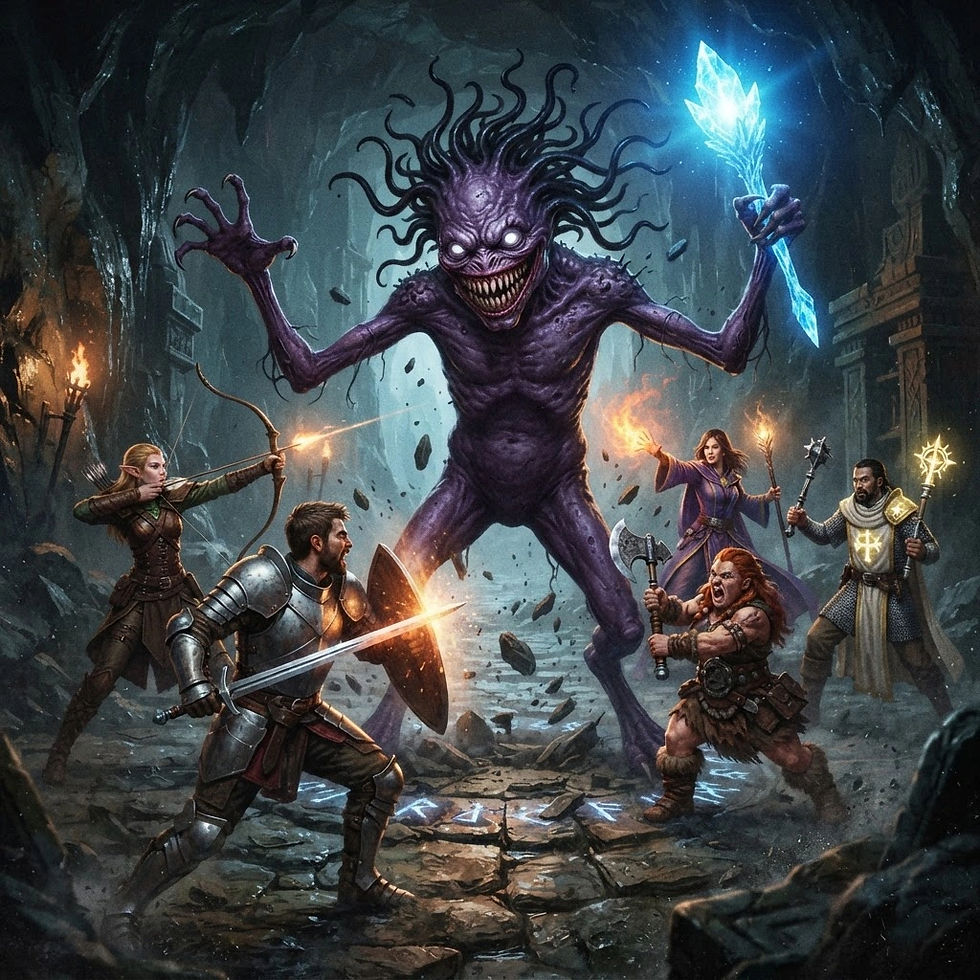
A group with excellent ranged capabilities may dominate an open battlefield but struggle in confined spaces. A party specializing in melee combat may be extremely dangerous once it reaches an enemy but vulnerable during an approach. A group with powerful area attacks may destroy numerous weak opponents quickly, while a group focused on single target damage may prefer fewer powerful enemies.
This is one reason encounter-building formulas should be treated as guidelines rather than guarantees. Even systems with sophisticated encounter building mathematics acknowledge that party size and composition can influence the actual challenge.
For a Game Master, the practical lesson is simple. You should know what your players are good at. Do not automatically punish them for being effective. If the players have developed a clever strategy, allowing that strategy to work is part of the reward of character progression.
At the same time, do not design every encounter around the party's strongest tactic. Variety is usually more interesting than repeatedly forcing players to solve the same mathematical problem.
Understand Action Economy When Designing Encounters
One of the most important concepts in balanced combat is action economy. Action economy describes the amount of meaningful activity each side can perform during a combat round. A single extremely powerful creature may look terrifying on paper, but if four or five characters can collectively take many more meaningful actions than that creature, the party may overwhelm it quickly.
Conversely, a group of individually weak enemies can become surprisingly dangerous when they collectively gain many opportunities to attack, reposition, disrupt, or control the battlefield. Encounter design discussions consistently identify action economy as one of the major factors that can cause a fight to perform differently from its numerical expectations.
This creates an important design principle. Do not evaluate an enemy in isolation. Evaluate what the entire battlefield can do during a round.
Imagine a party of four characters fighting one powerful creature. The creature might have enormous durability and devastating attacks, but it still has to contend with several opponents making decisions against it.
Now imagine the same party fighting a commander accompanied by four lesser creatures. The commander may be weaker individually than the original monster, but the battlefield now contains multiple threats capable of occupying the characters' attention.
Neither encounter is automatically better. The first may create a dramatic boss duel. The second may create tactical chaos. The key is understanding the difference.
Use Enemy Roles to Create Tactical Variety
Balanced encounters become considerably easier to design when enemies have different purposes.
Instead of creating five enemies that all attack the nearest character, consider what each enemy contributes to the battlefield. One creature might be physically powerful and attempt to control space. Another might attack from range. Another might support its allies. Another might attempt to disable a particular character. A commander might coordinate the group rather than simply dealing damage.
This does not mean every encounter needs five different enemy types. In fact, too many distinct enemy mechanics can slow combat and increase the Game Master's workload. Encounter-design guidance commonly recommends keeping enemy variety manageable so that tactical depth does not become unnecessary complexity.
A better approach is to give a small number of enemies clearly different battlefield functions. A brute creates pressure. A controller creates positional problems. A ranged attacker punishes exposed characters. A support creature changes the priority of the battle.
A commander changes enemy behavior. Suddenly, players have choices.
Terrain Is One of the Best Encounter Balancing Tools
Terrain is often overlooked because Game Masters naturally focus on character statistics and monster abilities. Yet terrain can completely transform an encounter without requiring you to redesign the monsters.
A narrow bridge creates positional pressure. A forest provides concealment. A ruined temple creates vertical opportunities. A collapsing cavern introduces a time limit. A frozen lake creates movement hazards. A battlefield filled with magical energy may periodically alter the rules of the fight.
Terrain can also compensate for an encounter that is slightly too easy or too difficult. If the enemies are overwhelming the party, environmental advantages might provide the characters with defensive positions, escape routes, or opportunities to divide their opponents.
If the encounter is too easy, terrain can introduce additional complications without simply increasing enemy hit points. This is particularly useful because increasing monster durability can make combat longer without making it more interesting. A difficult fight is not necessarily a fight that takes longer.
Give Players More Than One Way to Win
One of the strongest techniques for designing engaging combat encounters is to create multiple paths toward victory. The obvious path should still exist. Players should generally be able to defeat enemies through combat if that makes sense within the scenario.
But perhaps they can also collapse a passage, activate an ancient defense mechanism, steal an artifact, force an enemy commander to surrender, rescue an imprisoned ally, or escape with the information they came to obtain.
This transforms combat from a mathematical exercise into a problem solving experience.
A number of encounter design resources now emphasize adding objectives and complications beyond simply reducing enemies to zero hit points. The important thing is not to overload every encounter with complicated objectives. One meaningful complication is often enough.
Design Combat Around Player Decisions
A balanced encounter should create decisions with consequences. If the optimal strategy is immediately obvious and never changes, players can become spectators to a predictable sequence of attacks. Instead, create moments where the players have to choose.
Do they focus on the heavily armored enemy or eliminate the enemy mage?
Do they chase the fleeing commander or protect the wounded NPC?
Do they spend a powerful ability now or save it for the possibility of something worse?
Do they hold their position or retreat?
Do they divide their forces or remain together?
These decisions are what make combat feel like roleplaying rather than simply rolling attacks. This is particularly important in systems that emphasize player freedom. A classless, skill based RPG such as Gods of Aumin can benefit greatly from encounters that allow characters to solve problems through different combinations of abilities rather than forcing every situation into a predetermined combat role.
In Gods of Aumin, the broader design philosophy centers on freedom beyond traditional character classes, skill based play, experience driven advancement, and long term character progression from mortal adventurer toward increasingly powerful forms of existence. That kind of system naturally rewards encounters where the Game Master establishes a problem rather than prescribing the solution.
Balance Resource Consumption, Not Just Hit Points
Another common mistake is evaluating encounter difficulty solely by asking whether the characters might die. That is too narrow. An encounter can be balanced because it forces the party to spend meaningful resources without threatening a total party kill.
Characters might use powerful abilities, consumable items, healing resources, ammunition, magical energy, or other limited capabilities. In systems where characters have extensive long term progression, the Game Master should also consider how much the encounter contributes to the campaign's overall resource economy.
A difficult encounter immediately followed by another difficult encounter may become dramatically harder than either fight considered individually. This is why encounter difficulty must be considered within the context of the adventuring day, adventure, or campaign rather than treating every battle as an isolated event. A fight that seems moderate at the beginning of an adventure could become deadly after the party has already endured several encounters.
Avoid the Common Mistake of Making Enemies Too Powerful
When a combat encounter feels too easy, the instinctive response is often to increase enemy damage or hit points. That can work, but it is usually not the most interesting solution. Increasing damage makes the encounter more dangerous. Increasing hit points makes it longer. Neither necessarily makes it better.
Instead, consider giving the enemy a new tactical option, changing the battlefield, introducing reinforcements, giving the enemy an objective, or allowing the environment to become increasingly dangerous. This approach increases decision pressure rather than merely increasing mathematical punishment.
Likewise, if an encounter is becoming too difficult, the solution does not necessarily need to be obvious assistance from the Game Master. The characters might discover an environmental advantage, exploit an enemy weakness, force a morale check, discover a new escape route, or accomplish their objective without defeating every opponent. This preserves the feeling that the players solved the problem rather than simply being rescued by the narrative.
Use Morale and Enemy Behavior to Make Combat Dynamic
Not every enemy should fight to the death. Intelligent enemies may retreat. Cowards may surrender. Fanatics may become more dangerous when cornered. Mercenaries may flee when their commander dies. Monsters may protect their young rather than pursue fleeing characters. This adds another dimension to encounter balance.
If the party defeats the enemy commander, perhaps the remaining soldiers retreat. If the characters destroy the creature's nest, perhaps the monster abandons the fight. If the enemy's objective becomes impossible, perhaps continuing the battle no longer makes sense.
These behaviors can shorten combat naturally while making the world feel more believable.
They also give players another way to influence the battlefield. Victory does not always have to mean extermination.
Balance Boss Encounters Differently
Boss encounters deserve special consideration. A boss should feel different from an ordinary enemy. Simply increasing its statistics can make the creature stronger without making it memorable.
A better boss encounter gives the enemy a distinctive identity. The boss might alter the battlefield, summon reinforcements, change tactics when wounded, manipulate the environment, pursue a secondary objective, or possess multiple phases of behavior. The objective should also reinforce the boss's identity.
A necromancer might be attempting to complete a ritual. A warlord might be trying to escape with an artifact. A divine entity might be attempting to reshape reality. A dragon might be defending something rather than simply trying to kill intruders.
This is particularly appropriate for high level and mythic fantasy campaigns. In Gods of Aumin, where character progression can ultimately extend from mortal adventurers toward heroes, demigods, and gods, encounter design can scale beyond conventional dungeon fights into conflicts involving powerful beings, civilizations, deific forces, and world changing consequences.
The greater the characters become, the more important it becomes for the Game Master to think about objectives, environments, consequences, and scale rather than relying solely on numerical increases.
Test and Adjust Your Combat Encounters
No encounter building formula can predict exactly what a real group of players will do.
Players will find strategies you never considered. They will interpret clues differently. They will exploit terrain. They will roll exceptionally well or catastrophically badly. They may completely ignore the solution you expected and create something better. That is not a failure of encounter design. It is tabletop roleplaying.
The best Game Masters therefore treat encounter design as an iterative process. Pay attention to which fights your players remember, which tactical decisions they enjoy, which battles drag, and which encounters consistently produce excitement.
If your players routinely defeat encounters without spending meaningful resources, you may need to increase tactical complexity or introduce stronger objectives.
If they frequently feel that victory depends entirely on luck, examine whether the encounter gives them enough opportunities to make meaningful decisions.
If combat regularly takes too long, consider reducing enemy durability or simplifying enemy abilities rather than automatically lowering difficulty.
The goal is not to create mathematically perfect combat. The goal is to create meaningful combat.
The Golden Rule of Balanced Encounter Design
The most important lesson is that balanced combat encounters are not built from statistics alone.
Start with purpose. Understand the capabilities of the party. Consider action economy. Give enemies meaningful roles. Use terrain. Establish objectives. Create consequential decisions. Consider resource consumption. Allow enemies to behave intelligently. Make boss encounters distinct. Then use the rules and mathematics of your particular RPG as tools for refining the encounter rather than treating them as absolute predictions.
A truly balanced encounter should leave players thinking about what they did afterward.
They should remember the desperate decision to hold the bridge, the moment someone sacrificed their position to rescue an ally, the unexpected use of an environmental feature, or the terrifying moment when the enemy changed tactics.
That is what encounter balance is ultimately about. Not making combat predictable. Making the outcome uncertain while keeping the players' choices meaningful.
For Game Masters who enjoy classless progression, skill based fantasy, high player agency, and campaigns that can grow from mortal adventures into mythic conflicts, Gods of Aumin offers another perspective on what long form fantasy roleplaying can become. The system is designed around d100 based skill checks, experience driven advancement, reputation and faith, and an expansive progression from mortal character toward heroic and divine power.
Whether you are running Gods of Aumin, D&D, Pathfinder, RuneQuest, or another tabletop RPG, the same fundamental principle applies. The best encounter is not necessarily the one that is mathematically equal. It is the one that gives players a difficult problem, meaningful choices, and the freedom to create their own victory.


Comments