

D100 RPGs With High Level Progression

D100 roleplaying games have a distinctive appeal. Instead of reducing a character’s abilities to a small collection of broad numbers, percentile systems can make advancement feel granular, transparent, and deeply connected to what a character actually does during a campaign. A skill of 65% communicates something immediately about the character being capable, but that failure still remains possible. That simple relationship between probability and character ability is one reason D100 RPGs have remained relevant for decades.
But what happens when a campaign goes beyond ordinary adventuring?
What happens when characters become legendary heroes, world shaping figures, demigods, or even gods?

That question leads to a particularly interesting corner of tabletop roleplaying, D100 RPGs with high level progression. Many percentile systems excel at skill based character development, but campaigns can eventually reach a point where traditional advancement models begin to feel insufficient. Characters become exceptionally skilled, powerful abilities accumulate, and Game Masters must find new ways to create meaningful challenges.
For players searching for a D100 RPG with long term progression, a RuneQuest alternative, a skill based fantasy RPG, or a tabletop RPG capable of supporting truly epic characters, understanding how high level progression works is essential. The important question is not simply how large the numbers can become. The real question is whether the game continues to provide meaningful choices after characters have mastered the fundamentals.
What Is a D100 RPG?
A D100 RPG is a tabletop roleplaying game that uses percentile based mechanics as a central part of task resolution. In many systems, players roll a D100 and attempt to roll at or below a relevant skill or characteristic. Because the result is expressed as a percentage, players can quickly understand their approximate chance of success.
Percentile mechanics have a long history in tabletop roleplaying. RuneQuest became an especially influential example of skill based percentile fantasy gaming, while Basic RolePlaying helped establish a flexible framework that could support different genres and settings. Modern systems such as Mythras continue to use percentile mechanics as the foundation for character development and task resolution.
The appeal is straightforward. A D100 system gives players a detailed spectrum between novice and master. A character with a 35% skill and a character with an 85% skill are meaningfully different, even though both technically possess the same ability. That granularity becomes particularly interesting during long campaigns.
Why High Level Progression Matters in D100 RPGs
Many fantasy campaigns begin with relatively ordinary goals. Characters might be protecting a village, investigating an ancient ruin, hunting a dangerous creature, or attempting to survive their first encounter with a powerful enemy. Eventually, however, successful adventurers become something else.
The character who once struggled against a bandit may eventually defeat an entire squad alone. The apprentice magician may become one of the most influential spellcasters in the world. The warrior who began as an unknown mercenary may become a legendary commander. This creates a fundamental design problem for high level tabletop RPGs.
How do you continue making progression meaningful after characters become extremely competent?
Simply increasing numbers is rarely enough.
A character with a 90% skill is not necessarily more interesting than one with a 70% skill if the only difference is that the first character succeeds more often. High level progression becomes compelling when advancement changes what characters can accomplish, what responsibilities they possess, and what kinds of problems they encounter.
This is one of the great strengths of skill based RPG design. Because progression can occur incrementally rather than through rigid level structures, characters can continue developing in directions that reflect their experiences and ambitions. Mythras, for example, explicitly uses skill advancement rather than traditional levels as its progression model.
RuneQuest and the Tradition of Percentile Fantasy
Any discussion of D100 fantasy RPGs naturally leads to RuneQuest. RuneQuest helped establish a style of roleplaying in which characters are defined extensively by skills, cultures, professions, combat abilities, magic, and experience rather than simply by a traditional class and level structure. Its influence can be seen throughout the broader percentile RPG family.
For players searching for a RuneQuest alternative, one of the most important things to consider is not simply whether another game uses a D100. It is whether the system preserves the qualities that make percentile gaming attractive. That includes meaningful skills, understandable probabilities, character development through experience, and a campaign structure capable of supporting increasingly capable characters.
The D100 mechanic itself is remarkably flexible. The Mythras rules describe percentile resolution as providing a nuanced probability framework that supports opposed rolls, critical successes, fumbles, and other variations. Yet high level progression introduces another requirement, which is scale.
A game can be excellent at portraying a skilled adventurer without necessarily being designed to portray someone who eventually influences nations, commands supernatural forces, or challenges divine beings. That distinction matters.
Mythras and Skill Based Character Advancement
Mythras provides a useful example of how a D100 RPG can approach long term character development without relying on conventional levels. Characters are defined by skills, backgrounds, cultures, careers, relationships, magic, and other elements, with advancement occurring through skill improvement and the choices players make during the campaign.
This approach demonstrates an important principle of high level progression. A character does not need increasingly dramatic level numbers to feel like they are advancing. A swordsman becoming more accurate, a scholar becoming more knowledgeable, or a negotiator becoming more influential can all represent genuine progression. However, long campaigns eventually raise another question.
What happens when the character has become extremely good at nearly everything they regularly attempt?
At that point, progression needs to expand horizontally as well as vertically. Horizontal progression means gaining new capabilities, relationships, resources, magical options, leadership responsibilities, knowledge, influence, or narrative authority. Vertical progression means becoming more powerful at things the character already knows. The best long term RPG systems can use both.
The Difference Between High Level and High Power RPGs
High level progression and high power progression are not necessarily the same thing. A high level character might have extensive experience, a wide collection of skills, and substantial influence without being capable of destroying a mountain. A high power character, by contrast, may possess extraordinary abilities that fundamentally change the scale of the campaign. This distinction is particularly important when designing a high level fantasy RPG.
Imagine a campaign that begins with characters investigating mysterious disappearances. Eventually they discover an ancient supernatural conspiracy. Later, they become heroes capable of defeating legendary monsters. Eventually, their decisions determine the fate of kingdoms. The campaign has increased in scale even if the underlying D100 mechanic has remained recognizable throughout. The most ambitious progression systems go even further. They allow the characters themselves to become part of the mythology.
What Makes a D100 RPG Good for Long Campaigns?
A strong D100 RPG for long campaigns needs more than percentile dice. It needs a progression philosophy.
First, advancement should feel connected to play. Players should understand why their characters are becoming more capable and how their choices contributed to that growth.
Second, progression should remain meaningful after the characters become highly competent. If every important challenge eventually becomes an automatic success, tension disappears.
Third, the game should introduce new dimensions of play as characters become more powerful.
This is where campaign scale becomes extremely important. A beginning character might care about surviving combat. A veteran might care about protecting an entire settlement. A legendary hero might care about preventing a war. A supernatural figure might care about the fate of civilizations. The rules therefore need to support more than stronger attacks and larger numbers. They need to support bigger consequences.
Gods of Aumin: A D100 RPG Designed for Extreme Progression
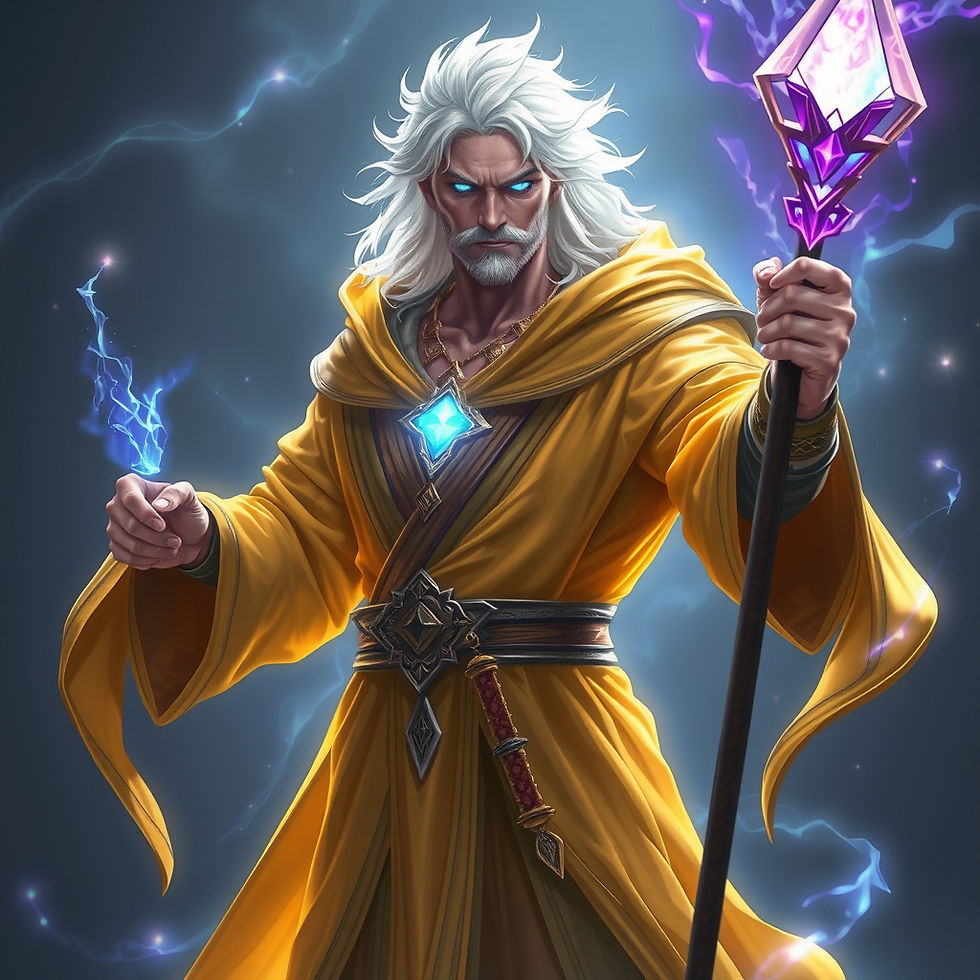
This is one of the ideas explored by Gods of Aumin, a classless mythic fantasy tabletop RPG built around D100 based skill checks and experience driven advancement. Rather than treating godhood as something that exists exclusively in the background of the setting, Gods of Aumin makes extraordinary progression part of the game's larger character journey.
The system begins from a familiar foundation for players who enjoy skill based percentile RPGs. Characters develop through their abilities and experiences rather than being confined to traditional character classes. But the intended progression can eventually move far beyond ordinary heroic fantasy. The central concept is a journey from Mortal to Hero to Demigod to God. That structure creates an unusual design challenge.
If a character can eventually become a god, what does progression actually mean after they have surpassed ordinary mortal limitations?
The answer cannot simply be "more hit points" or "a higher attack bonus." Instead, high level progression becomes about transformation. A character who reaches the upper tiers of a campaign should begin interacting with the world differently. Their reputation can become significant. Their faith can become meaningful. Their choices can influence civilizations. Their powers can have consequences beyond an individual encounter.
This makes the progression itself part of the campaign narrative.
From Skill Advancement to Mythic Progression
The transition from ordinary skill advancement to mythic progression is one of the most fascinating possibilities in a D100 RPG.
Early in a campaign, a player might ask, "Can my character survive this fight?"
Later, the question becomes, "Can my character defeat this legendary enemy?"
Eventually, the question might become, "What happens to the world if my character fails?"
That evolution creates a different kind of tabletop experience. Gods of Aumin approaches this concept through a classless structure in which characters can develop according to their experiences, abilities, ambitions, faith, and growing power. The system is designed specifically around the idea that a campaign does not necessarily need to end when characters reach the upper limits of conventional heroic fantasy.
For players interested in an RPG where you become a god, this creates an especially different progression model. The destination is not merely becoming the strongest character at the table. The destination is becoming something fundamentally different.
Why Classless D100 Systems Work Well for High Level Characters
Classless design can be especially useful for long term progression because it removes the assumption that every character must follow the same predetermined advancement path.
In a traditional class based RPG, a character's future abilities are often strongly influenced by their initial class selection. That structure can be useful because it creates clarity and identity, but it can also make extremely long campaigns feel predictable.
A classless, skill based RPG takes a different approach. Characters can develop according to what they actually do.
A warrior can become a scholar. A magician can become a political leader. A scout can become an accomplished diplomat. A religious devotee can develop extraordinary martial abilities.
At lower levels, this provides customization. At higher levels, it can create genuinely unusual legendary figures. That flexibility becomes even more important when a campaign crosses from heroic fantasy into mythic fantasy.
How to Keep High Level RPG Campaigns Challenging
The biggest challenge of extreme progression is maintaining meaningful conflict. If characters become overwhelmingly powerful, traditional enemies may stop working. A monster that once represented a terrifying threat can eventually become irrelevant. The solution is not necessarily to give every enemy bigger numbers.
Instead, Game Masters can increase the scope of the problem.
A legendary character may be able to defeat a monster easily but be unable to save an entire city from the consequences of that monster's actions. A powerful mage may be capable of destroying an enemy army but unable to determine which political faction deserves support. A demigod may be capable of defeating another supernatural being but still face difficult choices involving faith, loyalty, morality, and the future of civilizations.
This is where high level progression becomes dramatically more interesting than simple power escalation. The challenges become less about whether the character is strong enough and more about what the character chooses to do with that strength.
What Players Should Look for in a High Level D100 RPG
Players searching for the best D100 RPG for long campaigns should look beyond the basic dice mechanic. Ask whether the system provides meaningful advancement after the early stages of play. Ask whether skills remain useful as characters become more powerful. Ask whether the rules support increasingly dramatic adventures without abandoning the game's original identity.
It is also worth asking whether the system has an answer for the "endgame." Some RPGs are designed primarily around the adventuring phase of a character's life. Others are designed to let characters continue developing indefinitely.
For players who specifically want epic fantasy progression, the second approach can be transformative. A campaign becomes more than a sequence of adventures. It becomes the biography of a character whose influence grows alongside their abilities.
The Future of D100 High Level Progression
D100 systems remain compelling because their core mechanic is easy to understand while allowing tremendous mechanical depth. A percentile value provides a clear picture of capability, yet the surrounding rules can be expanded into almost any genre or level of play. The next evolution of D100 RPG design may therefore have less to do with replacing percentile mechanics and more to do with expanding what those mechanics can represent.
Traditional D100 gaming established a powerful foundation for skill based character development. Modern systems can build on that foundation with deeper customization, broader campaign scales, mythic progression, supernatural abilities, and increasingly consequential player choices.
That creates room for games that begin with the grounded uncertainty of percentile skill checks and eventually reach places that traditional adventuring games rarely explore.
For players who love D100 RPGs but want their campaigns to go further, that may be the most exciting possibility of all.
A character does not have to remain a capable adventurer forever. They can become a legend. They can become a force that changes history. And in systems designed around truly extreme progression, they may eventually become something that history itself has to remember.
Gods of Aumin explores that idea through a classless, skill based D100 fantasy RPG built around long term progression, mythic power, faith, reputation, and the possibility of ascending from mortal adventurer to god. The game's official website provides an overview of its core philosophy and upcoming release information.


Comments