

How to Improvise When Players Go Off the Rails
- Brian Done
- Jul 15
- 7 min read

One of the most common fears among Game Masters is the moment when players completely ignore the adventure that took hours to prepare. You spent days designing a mysterious dungeon, carefully balancing encounters, writing memorable NPC dialogue, and mapping every hallway. Then the party decides they'd rather investigate a random fisherman, adopt a stray wolf, start a trading company, or travel in the exact opposite direction.
If you've ever experienced this, you're far from alone. In fact, this moment is one of the defining characteristics of tabletop roleplaying games. Unlike video games or novels, players have genuine freedom. They aren't limited to scripted dialogue options or predetermined paths. They create the story through their decisions, and those decisions will almost always surprise you.
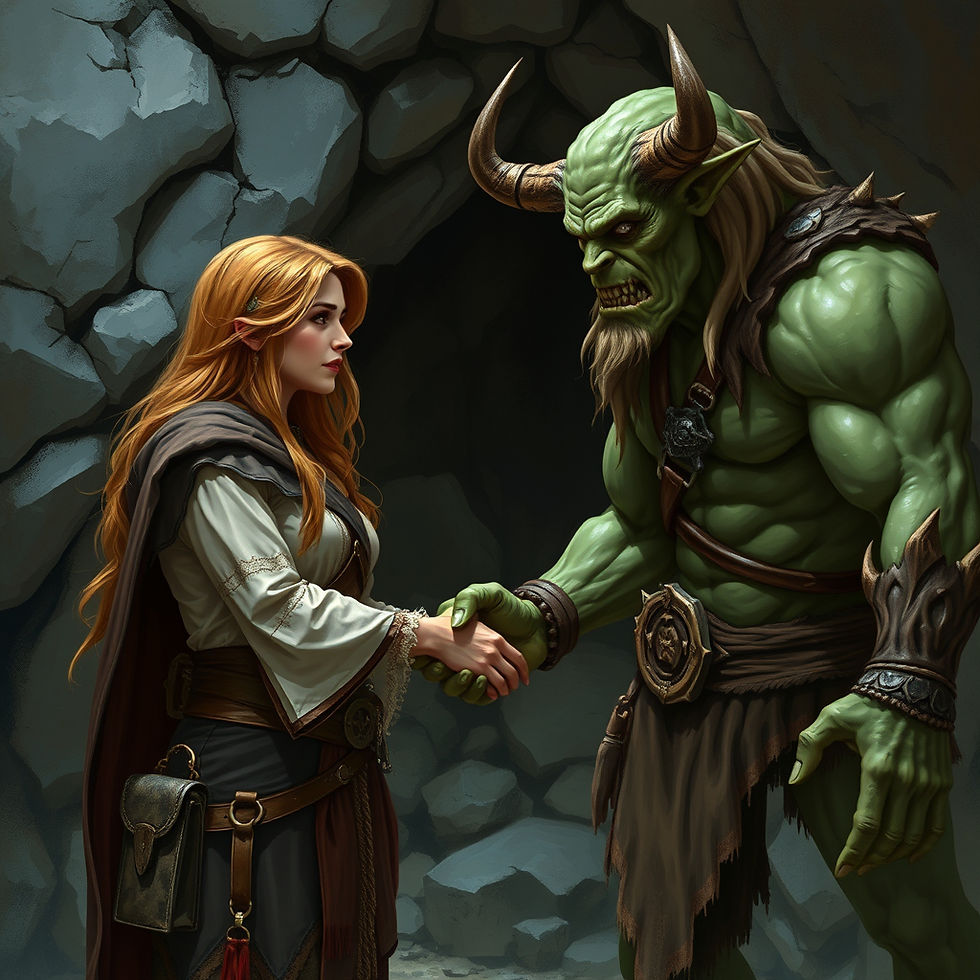
Learning how to improvise when players go off the rails is one of the most valuable skills a Game Master can develop. Improvisation doesn't mean making everything up without preparation. Instead, it means confidently adapting your world while maintaining consistency, immersion, and excitement. The more comfortable you become with improvisation, the more alive your world will feel.
Whether you play Dungeons & Dragons, Pathfinder, Call of Cthulhu, RuneQuest, or a classless skill based system like Gods of Aumin, these techniques will help you transform unexpected player choices into unforgettable adventures.
Why Players Going Off the Rails Is Actually a Good Thing
Many new Game Masters mistakenly believe that players leaving the planned adventure means they have somehow failed. The opposite is usually true.
When players make unexpected decisions, they're demonstrating that they feel invested in the world. They're thinking creatively instead of searching for the "correct" answer. They believe their choices matter, and that is exactly what tabletop roleplaying games are designed to encourage.
The goal of a great Game Master isn't to force players back onto the prepared path. The goal is to make every meaningful choice feel like it belongs in the world. The best campaigns often come from moments nobody planned. You can't use a mysterious force to make the players do what you want them to do.
Entire kingdoms have been created because players decided to spare a villain instead of killing them. Legendary NPCs have been invented because someone wanted to talk to the bartender instead of accepting the obvious quest. Long running rivalries have emerged because players accidentally insulted a noble during what was supposed to be a simple shopping trip.
Improvisation turns these unexpected moments into campaign defining memories.
Understanding the Difference Between Plot and Story
One of the biggest obstacles to improvisation is confusing plot with story. Plot is what you planned. Story is what actually happens. If you prepare a campaign expecting the heroes to travel through the haunted forest, rescue the prince, and defeat the necromancer, you've created a plot. But if the heroes decide to negotiate with the necromancer, ignore the prince, and instead unite several villages into an alliance, that becomes the actual story.
Experienced Game Masters prepare situations rather than scripts. Instead of planning exactly what players must do, prepare problems that exist independently of the characters.
Perhaps goblins are raiding nearby farms. Perhaps an ancient relic has disappeared. Perhaps political tensions are rising between neighboring kingdoms. These events continue unfolding whether or not the players intervene. Because the world keeps moving, you can adapt naturally whenever players choose a different direction.
Build Living Worlds Instead of Linear Adventures
Improvisation becomes dramatically easier when your campaign world feels alive. Instead of designing one perfect adventure path, think about how the world functions. Ask yourself questions like:
What are the villains doing today?
Which kingdoms are preparing for war?
What rumors are spreading through nearby towns?
Which merchants are arriving this week?
Who secretly wants power?
What disasters are approaching?
When your world has momentum, players can travel anywhere and still discover meaningful events. The campaign doesn't stop simply because they missed one quest. Instead, they find another piece of the living world. This approach creates the illusion that everything was planned from the beginning, even when much of it develops naturally during play.
The Secret to Successful Improvisation Is Preparation
This sounds contradictory, but the best improvisation comes from excellent preparation. Professional musicians improvise because they know music. Professional actors improvise because they understand their characters.
Likewise, Game Masters improvise because they understand their world. Rather than preparing every conversation word for word, prepare flexible resources. Know the personalities of important NPCs. Understand regional politics. Create several tavern names.
Keep a list of random merchant inventories. Prepare unusual weather conditions. Write down mysterious rumors. Design several generic battle maps that can represent many different locations.
These tools become building blocks that can be assembled in countless combinations during the session. Players rarely notice that today's abandoned watchtower originally existed as tomorrow's ruined temple.
Learn to Recycle Your Best Ideas
One of the greatest improvisation techniques is something many experienced Game Masters use constantly. Nothing goes to waste. Suppose you spent hours designing a haunted lighthouse. Instead, your players decide to travel inland. Don't throw the lighthouse away. Perhaps next week it becomes an abandoned wizard's tower. Perhaps it becomes an ancient observatory. Perhaps it becomes the ruins of a forgotten monastery.
The encounters, puzzles, treasure, and NPCs remain useful with only minor adjustments.
Your preparation is never wasted. It simply waits until the campaign naturally reaches it.
Keep NPC Motivations Consistent
Players may forget names. They almost never forget personalities. When improvising NPC interactions, focus less on detailed dialogue and more on motivations. Every important character should want something. A merchant wants profit. A king wants stability. A thief wants survival. A priest wants followers. A dragon wants knowledge.
If you understand what each character wants, conversations become surprisingly easy to improvise. Instead of memorizing speeches, simply ask yourself:
"What would this person do to achieve their goal?"
The answer almost always guides the interaction naturally.
Say "Yes, And" More Often
One principle borrowed from improvisational theater has become incredibly valuable for tabletop RPGs. Instead of saying "No," try saying "Yes, and..." When players suggest unusual ideas, look for ways they could succeed while introducing interesting complications.
Instead of saying: "No, you can't convince the guards."
Try: "Yes, the guards believe your story, but now they ask you to escort them to investigate."
Instead of: "No, the blacksmith won't build that."
Try: "Yes, but he'll need a rare ore that only exists inside dangerous mountains."
Player creativity becomes the beginning of new adventures rather than obstacles to the campaign.
Let Consequences Shape the Campaign
Improvisation isn't about letting players do anything without consequences. Freedom becomes meaningful only when actions matter. If players ignore the village requesting help, perhaps the village falls. If they betray an ally, word spreads. If they spare an enemy, that enemy may return later. If they become local heroes, merchants offer discounts.
When consequences feel believable, players become invested in the world because they understand it reacts to them. Their choices create history.
How Sandbox Campaigns Encourage Better Improvisation
Sandbox campaigns are often misunderstood. A sandbox isn't a world without direction.
It's a world with multiple directions. Rather than presenting one objective, sandbox campaigns provide many opportunities. Players decide which problems deserve attention.
Because no single storyline is mandatory, Game Masters naturally become more comfortable adapting to unexpected choices.
Many modern roleplaying systems embrace this philosophy because it emphasizes player agency over scripted storytelling. The result is a campaign that feels organic instead of predetermined.
Creating Flexible Encounters That Fit Anywhere
One excellent improvisation technique is preparing encounters without assigning them to specific locations.
Instead of writing: "The bandits attack at Bridge A."
Simply prepare: "A bandit ambush involving six mounted raiders."
Whenever the pacing feels right, introduce the encounter naturally. Perhaps it occurs on a forest road. Perhaps during mountain travel. Perhaps outside a city. The encounter remains useful regardless of where players choose to explore. This approach dramatically reduces wasted preparation.
Don't Panic During Silence
Many new Game Masters fear moments of silence. Experienced Game Masters embrace them. When players make an unexpected decision, it's perfectly acceptable to pause. Take a sip of water. Review your notes. Think for a moment. Players often assume you're considering dramatic consequences rather than scrambling to improvise.
Those few seconds frequently produce far better ideas than immediately blurting out the first thing that comes to mind. Confidence often comes from appearing comfortable with brief pauses.
The Best Improvisation Comes from Listening
Players constantly give Game Masters amazing ideas. Listen carefully to their theories. If players spend twenty minutes discussing whether the mysterious merchant is secretly working for a thieves' guild, ask yourself:
Wouldn't that actually be interesting?
Sometimes the players invent better mysteries than you originally planned. There's nothing wrong with quietly adopting their theories. From their perspective, you've just delivered an incredible plot twist. In reality, they unknowingly wrote it themselves.
Using Random Tables Without Feeling Random
Random tables are powerful improvisation tools when used thoughtfully. Rather than relying entirely on chance, use random results as creative inspiration. A random weather table might unexpectedly produce a violent thunderstorm.
Instead of treating that as background flavor, ask how it changes the adventure. Perhaps washed out roads isolate villages. Perhaps lightning awakens ancient ruins. Perhaps travelers seek shelter together inside an abandoned chapel. Random inspiration often produces stories that feel surprisingly natural.
Improvisation in Classless RPG Systems
Classless RPG systems often encourage improvisation because characters aren't restricted by predefined roles.
In Gods of Aumin, for example, characters develop through skills, faith, professions, reputation, and player choices rather than fixed classes. That flexibility encourages players to solve problems creatively instead of looking for class specific abilities.
When a campaign world supports open ended problem solving, Game Masters gain even more opportunities to reward clever thinking. Unexpected solutions become strengths rather than obstacles, allowing adventures to evolve naturally around the players' actions while preserving meaningful consequences.
Regardless of the system you play, the principle remains the same: build situations instead of predetermined outcomes, and let player decisions determine how events unfold.
Embrace the Unexpected
Some of the greatest stories in tabletop RPG history were never written before the session began. They emerged because players surprised the Game Master. The mysterious NPC who became a beloved companion. The random joke that evolved into campaign lore. The accidental villain. The kingdom founded by adventurers who simply wanted somewhere to retire.
Improvisation isn't about perfection. It's about confidence, flexibility, and trusting that collaborative storytelling creates experiences no amount of planning could ever replicate.
The next time your players ignore your carefully prepared dungeon and decide to chase a rumor about a talking crow instead, smile.
That crow might become the beginning of the greatest adventure your group ever tells.
The more you embrace improvisation, the less you'll fear players going off the rails. Eventually, you'll start hoping they do, because that's often where the most memorable stories are waiting to be discovered.


Comments